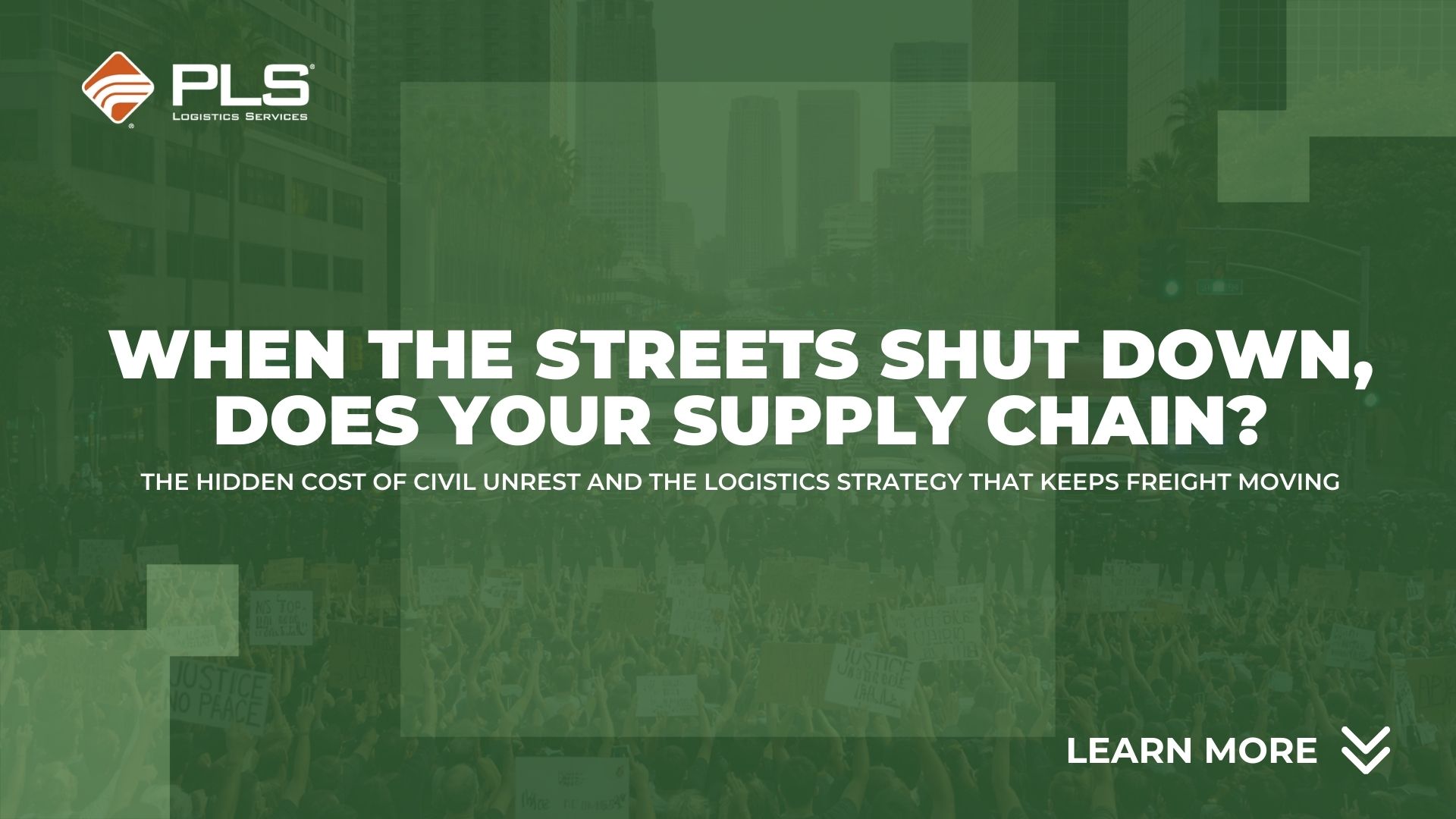
A single road closure can stall thousands of shipments. A port strike can freeze millions in inventory. A regional protest can send freight rates climbing overnight. Civil unrest rarely starts inside a warehouse, but it almost always ends up affecting one.
In today’s interconnected supply chain environment, instability in one location quickly becomes disruption everywhere. Transportation networks tighten, capacity shifts, inventory plans unravel, and customer expectations remain unchanged.
The question for logistics leaders is no longer whether disruption will happen. It is whether your supply chain is built to absorb it.
The Real Impact of Civil Unrest on Supply Chains
Civil unrest disrupts supply chains in ways that are immediate, measurable, and often underestimated.
1. Transportation Interruptions
Road closures, rail blockages, port slowdowns, and curfews create sudden freight bottlenecks. Even short term disruptions can cascade through multi stop routes and intermodal networks, creating delays days or even weeks downstream.
2. Capacity Imbalances
When certain regions become unstable, carriers reallocate equipment and drivers to safer lanes. The result is regional capacity shortages, volatile spot rates, and increased competition for trucks.
3. Port and Border Delays
Global supply chains are especially vulnerable. Labor strikes and political instability near ports increase dwell times, trigger demurrage charges, and disrupt drayage schedules. Containers stack up while inventory sits idle.
4. Inventory and Production Disruption
Delayed inbound materials slow production lines. Missed outbound deliveries create stockouts. Customers feel the impact immediately, even if they never see the root cause.
5. Rising Freight Costs
Disruption compresses timelines and increases risk. Rates rise accordingly. Companies operating without flexibility often pay a premium to recover. Civil unrest may be unpredictable, but its impact on logistics is consistent. Reduced visibility, reduced capacity, increased cost.
6. From Reactive to Resilient
Too many supply chains operate reactively. A load is tendered, a delay occurs, a solution is found, and the cycle repeats. That approach works in stable environments. It fails in volatile ones. Resilience requires preparation, visibility, and optionality. That is where the right logistics partner becomes a strategic advantage.
At PLS Logistics Services, we manage more than one million loads annually across truckload, LTL, rail and barge, air and ocean, and intermodal. Our approach is designed to reduce exposure before disruption happens and respond decisively when it does.
How PLS Helps Prevent and Solve Disruption
A 55,000 Plus Vetted Carrier Network
When one region tightens, flexibility matters. Our expansive, vetted carrier network provides immediate access to alternate routing, mode shifts, and supplemental capacity. If a primary lane becomes unstable, we have the depth to pivot quickly.
Instead of scrambling for coverage, our customers gain built in contingency options.
Single Point of Contact, Consolidated Communication
Disruption creates confusion. Multiple carrier contacts increase it.
PLS provides a single point of contact who manages carrier coordination, real time updates, and proactive communication. When conditions shift, you are informed early, not after a missed delivery.
Clarity reduces risk. Transparency builds confidence.
Proprietary Technology, Real Time Visibility
Our customizable transportation management system, PLS Pro, delivers real time shipment tracking and actionable reporting.
During unstable conditions, this visibility allows customers to identify exposure at the lane level, monitor performance metrics, and make faster operational decisions. If a workflow needs to change, we build it. No rigid systems, no generic dashboards.
Strategic Rate Management
Civil unrest often triggers rate spikes in affected regions. Our network scale and buying authority allow us to negotiate competitive pricing and balance spot and contract strategies to protect margin.
It is not just about securing capacity. It is about doing so strategically.
Scenario Planning and Risk Mitigation
True resilience begins before the crisis. We work with customers to evaluate high risk lanes, assess alternate ports or hubs, diversify modal strategies, and reduce overreliance on single points of failure.
The goal is simple, maintain service levels even when conditions shift.
Turning Disruption Into Advantage
Every supply chain is tested eventually. Some absorb the shock and continue delivering. Others fall behind.
Organizations with diversified carrier networks, proactive communication, and scalable technology do not just survive civil unrest. They outperform competitors who are slower to adapt.
At PLS Logistics Services, our mission is to empower supply chains through expertise, innovation, and accountability. We combine industry insight, advanced technology, and committed specialists to keep freight moving, even when the environment is unpredictable. Civil unrest may be outside your control. Your logistics strategy is not. If you are evaluating your exposure or looking to strengthen your supply chain resilience, our team is ready to help.